1. Introduction: Progress and Decline, Evolution and the Primitive
The idea of “decadent art” is well-known from its use against cultural elements often associated with Jewish artists during the Nazi era.1 But, as Paul Feyerabend (1924- 1994) points out, the idea of Verfall was well-established in the Renaissance recovery of classical ideals, revitalizing Hellenic art against supposed Roman decay, degradation, or “barbarization,”2 the same ideals Feyerabend also reads in connection with the discovery of perspective along with the social elevation or transformed status of the artist.
The constellation is essential for an understanding both of Feyerabend’s interest in art, including Dadaism, Avantgarde, modern and abstract art as well as his interest in Brecht.3 Where things become complicated will be in connection with what was crucial for Feyerabend’s philosophy of science in connection with the idea of progress as such, as if toward just one goal, one truth, one culture. This Feyerabend would contest—as did Friedrich Nietzsche4 —in his thinking on science. Today we are closer to beginning to understand Feyerabend’s insistence on “epistemological pluralism” if this notion often continues for many thinkers to be compatible with an evolutionary ideal of truth towards which “science,” so the conviction, inexorably tends. This ideal of progress Feyerabend challenged quite for the sake of understanding science throughout his work especially patent in Against Method. This contestation permits him to reflect on the point of Ivan Illich’s edifying gloss of Hugh of St Victor’s Didascalicon—“Never look down on anything” (Illich, 1993: p. 29)5 —as Feyerabend emphasizes in the title of the third chapter of Against Method: “There is no idea, however ancient and absurd, that is not capable of improving our knowledge” (Feyerabend, 1975/1988/1993: p. 5—see also pp. 33-34).
In Feyerabend’s posthumous, Quantum Theory and Our View of the World, in a Heinleinesque section entitled, “Humans as Aliens in a Strange World,” Feyerabend explains that the Gnostic movement, for example, occurred at a time of uncertainty when humans seemed subjected to irrational political and cosmic forces and when help seemed far away. Here are humans “as they really are,“ i.e., “their souls are imprisoned in bodies and the bodies in turn are imprisoned in a material cosmos. This double imprisonment, effected by low-level demons, prevents humans from discovering the truth: the more information they possess about the material world, the more they get involved in it, the less they know. Revelation frees them from their predicament and gives them genuine knowledge“ (Feyerabend, 1999: p. 168).
Teasing his former colleague, Joe Agassi, for his limitations as a reader in Science and Society, concerning “The Strange Case of Astrology,” Feyerabend contends that today’s scientists and, by extension, philosophers of science, have little hesitation when it comes to denouncing things about which they are utterly ignorant, knowing only that it cannot be true to which habitus Feyerabend opposes —the example is meant to be extreme — the Church and the Inquisition, analyzing the exigence of the logical argument and case structure of the Malleus Maleficarum,6 but also inasmuch as, as Nietzsche also observed, the notion of a singular and ideal truth has analogies with traditional theology (see Babich, 2014).
Feyerabend’s Wissenschaft als Kunst [Science as Art — this should not be translated as “Science as an Art”] (Feyerabend, 1984), must be read in the context of a debate on the sheer idea of progress per se. Feyerabend uses progress in art in analogy with the ideal of scientific progress as these themes feature in his posthumously published (but contributed, so Bob Cohen told me in conversation, in Feyerabend’s lifetime to Cohen’s Festschrift), under the title of “Art as a Product of Nature as a Work of Art” (Feyerabend, 1995), an essay reflecting Feyerabend’s protracted interest in what German speaking scholars call Naturphilosophie, a tradition which attracted both Feyerabend’s mentor/nemesis, Karl Popper and his friend, the physicist, Erwin Schrödinger.
It goes without saying that arguments contra non-received themes also support excluding knowledge traditions, including certain styles of philosophical approaches to philosophy as to the philosophy of science and history along with anthropology and sociology of science in addition to excluding aention to whole historical epochs, this Pierre Duhem (among others but Duhem at remarkable length)7 sought to challenge in medieval cosmology and also, as we are slowly learning to do with respect to different traditions of ancient science, Hellenistic, Chinese, Indian, etc., and, as Feyerabend argued at length, stone age culture as well.8
2. Wissenschaft als Kunst/Science as Art
Introducing his 1981 inaugural lecture in Zrich: “Wissenschaft als Kunst” Feyerabend compared the concept of scientific “progress” with “progress” in art (Feyerabend, 1984: p. 7).9 The nuanced opposition to the idea of (simple) progress is the heart of Against Method and there are several versions of Feyerabend’s thinking on progress in science.10 In art, Feyerabend argues contra the Renaissance theory of barbaric external depredations or internal decay [Verfall] that also found expression in Nazi arguments against Avant Garde and modern art as “degenerate” [Entartung].
Fig. 1: Brunelleschi’s Experiment in (Feyerabend, 1984)
In addition to clarifying Emmanuel Löwy’s (1857-1938) discussion of the complex advances of archaic style in Greek art, Feyerabend foregrounds Aloïs Riegl (1858-1905),11 the art theorist who revolutionized art historical research quite thematically as a “science”12Kunstwissenschaft, qua science, as Friedrich Nietzsche (1844-1900), if he does not typically tend to be read in this fashion, had likewise highlighted as “aesthetic science [ästhetische Wissenschaft]” in his first book on The Birth of Tragedy out of the Spirit of Music, as Nietzsche himself draws on his own inaugural lecture on the “Homer problem” that would also engage Feyerabend.13 Nietzsche maintained that in his first book he put science as such on the very Kantian “path of a science,” raising the question of science as “a problem, as question-worthy.”14
Claiming to be the first to have posed this question and the reflexive significance of the indispensability of the ‘ground of art [Boden der Kunst]’ inasmuch as “the problem of science cannot be cognized on the ground of science [denn das Problem der Wissenschaft kann nicht auf den Boden der Wissenschaft erkannt werden]” (Nietzsche, 1980: vol. 1, p. 13), Nietzsche had claimed a revolutionary turn while also, thus the irrecusable connection with the question of style, making the scientific case that it was style that exemplified the ‘science’ of his own scientific field of ancient Greek philology. In other words, as Nietzsche explained in his Basel lecture, the expert designation—this is technically what is called the “Homer question”—of “Homer as composer of the Iliad and the Odyssey is no historical tradition but an aesthetic judgment” (Nietzsche, 1869/1994: vol. 5, p. 299). Feyerabend cites Nietzsche on “truth and lie” along with Nietzsche’s Philosophy in the Tragic Age of the Greeks and it is important to note that in both texts Nietzsche highlights “style.”
If Nietzsche’s thinking on truth and lie is prototypically incendiary—classical “dynamite” for standard philosophical thinking on science—Henri Zerner argues that in his foundational contributions to art history, Aloïs Riegl’s innovations also undermined all the fundamental convictions of traditional art history. These convictions have by no means disappeared today. They are not, it is true, very comfortably held, but neither have they been replaced by what one might call a new paradigm (Zerner, 1976: p. 179).
What drew Feyerabend’s attention in his analogy, “Wissenschaft als Kunst [Science as Art]” was Riegl’s opposition to a patent presumption of aesthetic “progress,” whereby historically prior traditions are esteemed as less advanced, accomplished or competent than subsequent traditions. This Feyerabend recalls as the standard assumption of Vasari’s account of the evolution of Renaissance art (Feyerabend, 1999: pp. 89-90). It is this same assumption that drives the classification (the language) of assessing art of certain historical periods as “decadent” (see, broadly, Kuspit, 1994, 2000; and Kaye, 2020) with notorious consequences in the case of Nazi aesthetics, as already noted at the outset, but which led, here to use Jás Elsner’s terms, to characterizing “late antiquity as the fag-end and dust-bin of a dying aesthetic” (Elsner, 2021). It was this valuative ideal of the progress of art that Riegl refused. Hence where Vasari articulated a progressive schema in the “evolution” of art, Riegl’s account of the history of art articulated a properly scientific, comparative historical analysis beginning with the art of antiquity in Egypt, Greece, Rome, Byzantine, Islamic, Germanic, showing art in tension with or else “improving on nature” in various ways and subject to contextual as opposed to absolute acme and decline (Riegl, 2004).
Summary glosses of Riegl’s contributions to scholarly, scientific thinking on the history of art highlight his concept of Kunstwollen (‘wollen’ is difficult to translate, ergo hermeneutically “elusive,” here again to use Zerner’s words, “because it seems to vary with its context” [Zerner, 1976: p. 180). Contemporary scholars find themselves challenged to situate Riegl, as they claim his “limited citation of sources” (Gunser, 2005: p. 453), but such a claim typically frees scholars to reconstruct these, thus Rebeka Vidrih positions Riegl between von Humboldt’s “Bildung durch Wissenschaft“ and Dilthey’s conception of the Geisteswissenschaften (Vidrih, 2023 : p. 1), and so on. The distinction is complicated for Feyerabend, who never failed to point out that rigorously or “strictly speaking all sciences are Geisteswissenschaften” (Feyerabend, 1981: p. 12).
3. “Brunelleschi and the Invention of Perspective”
In The Conquest of Abundance, Feyerabend quotes Antonio di Tuccio Manetti’s speculative aesthetic analysis of the upper portion of the painting in which, according to Manetti, Brunelleschi had
placed burnished silver [in the painting] so that the actual air and the sky might be reflected in it, and so the clouds, that one sees reflected in the silver, are moved by the wind when it blows.15
This account has been called into question by the sculptor, Nigel Konstam (1932-2022), in his experimental (re-)construction, arguing that the mirror was a device, that is to say, expressly what Feyerabend called an “artifact” in his argument.
Konstam maintains there were two mirrors as the original painting, which has been lost for centuries, containing a sketched and painted substrate of silver quite as opposed to featuring, according to Manetti’s reasoning (which not based on observation) that the original painting included a mirror inlay of silver in order to provide a dynamic reflection of passing clouds in the sky.16 The historian of renaissance art, Samuel Y. Edgerton (1926-2021) observes that a subsequently added inlay, although common in other applications, used by an artist for such a purpose would have been a singular innovation: “as far as I know, no other artist before or aſter him had ever thought to do” (Edgerton, 2025).
Nigel Konstam, “Experiments in Perspective: Nigel Konstam Demonstrates his Preferred Hypothesis.”
According to Konstam’s video demonstration of his experimental reconstruction, Brunelleschi would have traced points for perspective projections for the painting directly on the silver mirror itself, thereby leaving unpainted what for Manetti appeared as sky, featuring passing clouds or whatever else is reflected (cf. Tsuji, 1990).
Konstam’s account is illuminating in several respects.
In Space-Perception and the Philosophy of Science, Patrick Heelan had emphasized that conventional or “artificial perspective” (i.e., classical perspective)17 was designed to reflect “the way Renaissance artists organized space predominantly according to the rules of mathematical perspective” (Heelan, 1983: p. 101). This is the same point Feyerabend makes at the outset, citing Richard Krautheimer and featuring Edgerton’s illustration of Brunelleschi’s engineer-artisanal “experiment” with respect to linear perspective (see Fig. 2 below).18
Fig. 2: (Feyerabend, 1999: p. 95.
For Edgerton and Feyerabend (and not less for Konstam’s artisanal reconstruction), the instruments or artifacts are key. But Edgerton emphasizes that everything used in Brunelleschi’s “experiment”—the mirrors, the panel, but also the original sketches, drafts, paintings made, have been lost—as well as the experimental practice, crucial to which, as Edgerton echoes Filarete, pointing out that Filarete was likely, because Manetti, too young at the time, would/could not have been a witness, and was thus “looking in a mirror” (Egderton, 1975: p. 134).
Therefore, reference to the perspective frame illustrated in Dürer’s treatise on measurement, Underweysung der Messung19 —which, it is worth noting, include the perspective points Konstam emphasizes, along with the use of mirrors and a fixed optic (see Fig. 3 below)—supported the claim that
the camera, like mathematical perspective, was developed to serve a pictorial vision that already defined the World to be of a certain kind and to assist painters to express this. (Heelan, 1983: p. 102)
In addition to his focus on Brunelleschi’s experimental set up or Gestell, Feyerabend argues against the Vasarian ideal of verisimilar artistic evolution or progress and to this end he draws on Riegl.20
Fig. 3: Albrecht Dürer, Underweysung der Messung, mit dem Zirckel und Richtscheyt, in Linien, Ebenen und ganꜩen corporen 1525 (Wikimedia Commons)
At issue is the concept of “progress,”21 including social progress relating to the rank or banausic standing of the artist. For Hans-Georg Gadamer, who cites both Karl Popper and Martin Heidegger, what is crucial is “the discovery of new questions” in the “emergence of a scientific problem” (Gadamer, 1998: p. 25). Gadamer argues that both Mill and Dilthey presuppose what may be regarded as “the objectivity of method” (Gadamer, 1998: p. 30). “Methodos,” for Gadamer, “always means the whole business of working with a certain domain of questions and problems” (Gadamer, 1998: p. 30). In this sense, the history of philosophy is not a history of “stable problems” (Gadamer, 1998: p. 28). For his own part, Feyerabend makes this claim with respect to the history of science. Thereby instability is ineliminable: “we are historical creatures,” an insight differently articulated in Riegl’s art-science: for Gadamer, “we are always on the inside of the history we are striving to comprehend” (Gadamer, 1998: p. 28).
Full pdf, including the following sections and complete reference list available here.
Notes
See, in general, although there are other studies—some cited in note 20 below—the essays collected in (Peters, 2014). ↩︎
See, for example, (Peirano, 2010). Such claims, and Nietzsche also discusses this, are related to efforts at cultural appropriation; see (Miles, 2015), as well as, also relevant for Feyerabend’s reference to Vasari (De Angelis, 2008). ↩︎
Val Dusek argues that this illuminates Feyerabend’s dialogue with Lakatos, see (Dusek, 1999). Dusek’s reading would have benefitted from further context, literature, references, etc. and should certainly be supplemented with Matteo Motterlini’s enlightening publication of their letters: see (Motterlini, 1999). See also, for further references and discussion (Babich, 2024). ↩︎
Illich’s gloss is meant as a comment on Hugh of St Victor’s Parvis imbutas tentabis grandia tutus which, Illich tells us Jerome Taylor translates more soberly as “Once grounded in things small, you may safely strive for all.“ ↩︎
For the reference to Inquisition (in the context of his argument re arguments contra astrology), see (Feyerabend, 1978: p. 92), and with reference to Gnosticism, noted above, Feyerabend sets the thought experiment: “Can we infer that the final product, i.e., nature as described by our scientists, is also an artifact, that nonscientific artisans might give us a different nature and that we therefore have a choice, and are not imprisoned, as the Gnostics thought they were, in a world we have not made?” in (Feyerabend, 1999: p. 138). ↩︎
See, in ten volumes (Duhem, 1913-1959). For a discussion, see, including reference to Feyerabend along with a discussion of Mach, (Babich, 1993/2003: pp. 187-194). ↩︎
See the first chapter of Feyerabend’s Naturphilosophie (Feyerabend, 2009/2018). To understand Feyerabend’s approach, it is salutary to compare, and note the subtitle, of (Meyer-Abich, 1997), because Meyer-Abich underlines ecological and political issues, not unlike if more ecologically focused than Feyerabend. ↩︎
Cf. (Feyerabend, 1986), and, again, (Feyerabend, 1995), a version of which also appears, among other loci, as a key chapter in his posthumous Conquest of Abundance (Feyerabend, 1999). ↩︎
See for a now classic objection—and strikingly but not exceptionally limited reading of Feyerabend— in (Theocharis and Psimopoulos, 1987). For a reflection on philosophy of science per se, see (Stuart, 2021). And, for a comparison of Feyerabend and Popper, see (Tambolo, 2015). ↩︎
To wit: Eine Diskussion der Rieglschen Kunsheorie verbunden mit dem Versuch, sie auf die Wissenschaften anzuwenden. See for a discussion of Riegl and Löwy, (Delarue, 2014) and, on Löwy, in English Alice A. Donohue’s discussion of Löwy’s rendering of nature in archaic Greek art in (Donahue, 2011), which she reads with the same reference to the Gombrich Feyerabend tells us he consults, reminding us that Gombrich was Löwy‘s student, highlighting, as this is also crucial for Feyerabend, Löwy’s discussion of the representation of space, although her reading of Löwy’s discussion of Homeric narrative might have benefitted from Feyerabend’s paratactic discussion. ↩︎
Cf., focusing on Aby Warburg and Ernst Gombrich (Vidrih, 2023) and see (Cordileone, 2014), and, for the relevance of the icon (Ionescu, 2013). ↩︎
See, including a reference to Darwin, (Babich, 2010). ↩︎
Nietzsche, 1980: vol. 1, p. 13; and for discussion, see Babich, 2009. ↩︎
Manetti, in The Life of Filippo Brunelleschi, ca. 1480, quoted in Holt, 1981: p. 171. In a note, Feyerabend tells us that he changes the translation, using “technical language where the text has none” (Feyerabend, 1981: p. 95). ↩︎
See (Konstam, 2025). I invoke some of Konstam’s material argumentation with respect to technique in (Babich, 2007), referring to (Konstam and Hoffmann, 2004). ↩︎
Embedded in this, as Erwin Panofsky argues, are two collimated conceptions of experimental perspective, “the perspectiva pingendi [painter’s perspective] or perspectiva artificialis [artificial perspective]” both of which were dependent on optics and frames and the artist’s specific staging (think of Dürer’s famous depiction of perspective, Fig. 3) and hence quite literally the child of optical theory and artistic practice-optical theory providing, as it were, the idea of the piramide visiva [the visual pyramid], artistic practice, as it had developed from the end of the thirteenth century, providing the idea of intersegazione [a plane intersection of the visual pyramid]” (Panofsky, 1960: p. 139). ↩︎
(Feyerabend, 1984: p. 19). In addition, generally, to (Krautheimer, 1965), Feyerabend also refers to (Edgerton, 1975). Significantly enough, the first chapter of Edgerton’s book begins—and one can note the influence of the terminology used beyond Feyerabend—as follows: “More than five centuries ago, a diminutive Florentine artisan in his late forties conducted a modest ‘experiment’ near a doorway in a cobbled cathedral plaza.” Edgerton’s illustration (followed by a comprehensive citation from Manetti) in (Edgerton, 1975: pp. 126-127) appears in Feyerabend’s chapter on Brunelleschi, noted as “after Edgerton” (Feyerabend, 1999: p. 95). Cf. (Heelan , 1983) for other references on Alberti and perspective. ↩︎
Albrecht Dürer, Underweysung der Messung, mit dem Zirckel und Richtscheyt, in Linien, Ebenen und ganꜩen corporen (as cited in Heelan, 1983: p. 102). ↩︎
Thus Feyerabend observes, contra Vasari that for Renaissance theorists, the elements of perspective, natural postures, delicate colours, character, emotions—are obstacles, not improvements for an artist who wants a portrait or a statue to convey absolute power or spiritual eminence: what is permanent and independent of circumstances (Feyerabend, 1987: p. 148). ↩︎
“Eine Diskussion der Rieglschen Kunsheorie verbunden mit dem Versuch, sie auf die Wissenschaften anzuwenden” (Feyerabend, 1984: p. 7). The theme seems to be absent from Eric Oberheim’s planned edition/translation of Feyerabend’s notes for Science as Art (Eric shared an advance copy with participants when I presented an earlier version of the current essay at a Spring 2024 Weimar colloquium on Feyerabend organized by Helmut Heit. ↩︎
My theme is ‘con-spiratio’ and Ivan Illich’s lecture on the ingredients or prerequisites of establishing a community or polity. In addition, I explore questions of culture in Illich’s conspiracy lecture along with the related question of grace, Illich’s ‘Umsonstigkeit.’ In addition to Illich on the parable of the good Samaritan and his meditation on ‘The Last Days of Savonarola,’ I note Antonio de Nicolas’s Powers of Imagining and his analysis of the role of the devotional writings of the Franciscan, Carthusian, Dominican, and Cistercian orders in the spiritual formation of Ignatius of Loyola (i.e., hermeneutico-phenomenologically, ‘how to be a saint’), along with Tracy Strong (writing on the imitatio Christi) and Alasdair MacIntyre (writing on oaths in After Virtue), with a tiny allusion to Simone de Beauvoir and Michel Foucault but also Paul Feyerabend and Nietzsche throughout.
Being an excerpt of a text currently available behind a paywall1
Go get yourself a culture, only then will you find out what philosophy can and will do.
— Nietzsche
Hans-Georg Gadamer (1900-2002) wrote about prejudice and the importance of critique, that is: being oneself exposed, personally, to challenge. For Gadamer this explicitly included an opposition to mass media in the mid-1980s and not less, as he made this notion of critical thinking explicit, questioning official truth narratives.
Speaking on “the idea of the university,” at the University of Heidelberg, Gadamer reminded his audience that “inquiry and research produces poor television viewers and newspaper readers.” 2
The claim requires its own hermeneutic, here to be heard in the German context where the standard of education, at least at a popular level, is the ability to read the newspaper with a certain dedication.
If today we worry more about ‘fake news’ and find scholars advocating for the uncritical acceptance of ‘official’ sources, for Gadamer, hermeneutically speaking:
We always ask: what is the motivation? What interests are being expressed? Why are we being informed about this? Is the aim to keep us within the limits of an administered social order?3
In addition to this critical emphasis, Gadamer reminded his audience that the university is exactly not a preparation for everyday life. Thus and very traditionally, “persons having received a theoretical training are often disappointed when they have to face practical life.”4
‘Disappointed’ would be putting it mildly.
The theoretical ideal here was Wilhelm Humboldt’s sense of the university and culture,5 and in this Gadamer articulates the free ideal of the so-called ‘liberal’ arts, just as many Anglophone readers might cite John Henry Cardinal Newman and Alasdair MacIntyre on the ‘very idea of the university.’6 For his part, Gadamer writes in the German tradition which is to say that he writes about Bildung, i.e., culture and cultivation, a word effectively untranslatable especially if translated as education, more technically: Erziehung,7 and a bit less, but in the same context, qua professional or trade formation, Ausbildung.8
Here I argue that Gadamer’s thinking on education, classical as it was, might be productively compared with Ivan Illich (1926-2002). Both thinkers were concerned with language and history, as one might expect in the case of Gadamer, a classicist and Illich, a historian, if Gadamer’s reflections on education might seem to have little in common with the contrarian author of Deschooling Society.9 Gadamer was a university professor, who taught at universities all his life where, by contrast, as Illich emphasized, Illich was ‘associated’ with universities, apart from a short-lived (and conflicted) position as vice-rector of the Catholic University of Puerto Rico, connected with Fordham and the University of Bremen and Hagen, and with teaching at Penn State, Illich was not a ‘professor’ per se and where Illich remained a Catholic and, despite rumours to the contrary, an ordained priest all his life, quite where Gadamer was a perfect ‘Protestant,’ Illich was a ‘perfect’ iconoclast.
Ivan Illich and Hermeneutics
I read Illich in concert with hermeneutics yet it can be argued that hermeneutics is fairly limited to Gadamer and Ricoeur (and others less discussed). Here the point would be that it might seem that there are sufficient divergences between Gadamer and Ricoeur. In addition, hermeneutics is multifarious, as any survey article will attest, including a number of alternate and sometimes disparate hermeneutic traditions.10 Nevertheless, just as Gadamer cites Husserl with respect to phenomenology when it comes to authority/tradition:
Phenomenology: that is I and Heidegger, and no one else.11
And, if absent Husserl’s self-reference, the present author would argue that Gadamer and Heidegger exemplify hermeneutics, there is a hermeneutic breadth that takes a step back to include Nietzsche if only for the sake of his 19th century context in classical philology on the reception and reading of ancient texts.12 It is in this framework that the case for hermeneutics can be made for Ivan Illich,13 especially with respect to his discussion of Hugh of St. Victor and not less Illich’s innovative, bodily articulation of textual-locative readerly hermeneutics.
The argument for reading Illich in connection with hermeneutics and education has been made explicitly,14 thus early responses to Illich’s Medical Nemesis highlighted parallels with hermeneutics in Gadamer and Ricoeur.15 But, and again, hermeneutic analyses of Illich remain rare when it comes to education. The point is hardly that Illich is ‘unknown.’ Almost everyone knows or else supposes that they know what Illich writes on ‘deschooling society.’ Yet engagement seems to end at the title and the substance of his argument is excluded in advance as scholars bristle at the idea of ‘deschooling’ or ‘disestablishing school’ at any level.
David Gabbard has explored this issue with a hermeneutic shift to Foucault’s language of ‘discourse.’ Thus, for Gabbard, although classically philological perspectives on the tradition of ‘commentary’ might disagree with the expression as articulated, “[i]nsofar as it speaks the never-before-said of an already-said, a commentary poses as a definitive restatement of some primary discourse.”16 Here we might recall Gadamer for hermeneutic nuance when he writes about the challenge of “learning to speak” — reminding us of the relative “genius of the three year old” as Gadamer puts it, as he might have echoed Piaget — any time we undertake any effort whatever at ‘translation’
we are familiar with the strange, uncomfortable, and torturous feeling we have as long as we do not have the right word. When we have found it the right expression (it need not always be one word), when we are certain that we have it, then it “stands,” something has come to a “stand.” Once again we have have a halt in the midst of the rush of a the foreign language, whose endless variation makes us lose our orientation. What I am describing is the mode of the whole human experience of the world.17
The context for Gadamer’s 1966 reflection recalls his earlier, Truth and Method as well as his lifelong engagement with Heidegger’s reflections on hermeneutic phenomenology. Indeed in his 1942 lecture course on Hölderlin’s Ister, it is worth underlining the fairly blunt force of Heidegger’s question as Heidegger interrupted his own reflection on the ‘strange’ as such, and the same terminological array in repeated in Gadamer concerning “The meaning of δεινόν” — a term Heidegger had already unpacked reading Sophocles in his 1935 Freiburg Introduction to Metaphysics — asking “who decides a translation?”18
‘Lexical’ definition as Heidegger speaks of this, referring to a dictionary, corresponds to what may be regarded as, qua definition, what the education theorist, David Gabbard summarizes as a decided and thus “definitive restatement of some primary discourse.” For Heidegger, the problem is — and this is the core of aletheological hermeneutics — that such “correctness,” however lexically definitive it may be, “does not guarantee us any insight into the truth of what the word means and can mean.”19 Heidegger concludes by explaining, and accords with Gadamer’s more relaxed formula of being ‘caught up short’ by a text in his reflections in Truth and Method, that to make
something understandable means awakening our understanding to the fact that the blind obstinacy of habitual opinion must be shattered and abandoned if the truth of a work is to unveil itself.20
That Heidegger’s formula — “Tell me what you think of translation, and I will tell you who you are” — would influence Gadamer is patent. In this way, Gadamer concludes a reflection on the human being and on language reflecting on what I elsewhere describe as the ‘penumbra’ of the word: a shadowed echo of everything around and in what is said in and by language. Thus Gadamer reflects on the task of the translator faced with “something said either verbally or in writing.”21 Gadamer’s observation concerns what is and what cannot be brought to word in the translation. The translation, note the essential negativity of Gadamer’s expression,
lacks that third dimension from which the original (i.e., what is said in the original) is built up in its range of meaning. This is an unavoidable obstruction to all translations.22
Hermeneutics is philologically indispensable as “no translation is as understandable as the original.” Translation does not, because it cannot, “facilitate understanding.” What is needed for that is what is promised by the German language sense of ‘carrying over,’ that is: über-setzen, über-tragen, and here Gadamer includes Heidegger’s unsaid in what is spoken:
The task of the translator, therefore, must never be to copy what is said, but to place himself in the direction of what is said (i.e., its meaning) in order to carry over that is to be said into the direction of his own saying. … What he has to reproduce is not what is said in exact terms but rather what the other person wanted to say and said in that he left much unsaid.23
The rest of the text can be found in the collection edited by Kamila Drapało, Barbara Weber, Klaudia Węc, and Andrzej Wiercinski: Subject, Identity, and Care: Educational (Dis)closures (Amsterdam: Brill, 2025) see first footnote below.
Hans-Georg Gadamer, “The Idea of the University” in On Education, Poetry, and History: Applied Hermeneutics (Albany: State University of New York Press, 1992), 58. ↩︎
See for a discussion in an Anglophone context relevant to hermeneutics and education, Pádraig Hogan’s dedicated article, “Integrity and Subordination in Educational Practice,” Counterpoints, Vol. 462, My Teaching, My Philosophy: Kenneth Wain and the Lifelong Engagement with Education (2014): 169-185, here: 181-182. For a discussion of the ‘idea of the university, as this is a broad theme, with a context that various from linguistic culture to linguistic culture, see for an Anglophone overview, Jeffrey J. Williams, “History as a Challenge to the Idea of the University,” JAC, Vol. 25, No. 1 (2005): 55-74. And see, Babich, “From Nietzsche’s ‘Educational Institutions’ to Jaspers and MacIntyre and Newman on ‘The Idea of the University,’” Existenz, Vol. 15, No 2, Fall 2020 [2022]): 17-31. ↩︎
Alasdair MacIntyre, “The Very Idea of a University: Aristotle, Newman, and Us,” British Journal of Educational Studies, 57/4 (December 2009), 347-362 See my Jaspers Society lecture with interventions by Tracy Strong and others online, https://www.youtube.com/watch?v=DHmUgac4y-4. ↩︎
See Walter H. Bruford, The German Tradition of Self-Cultivation: “Bildung” from Humboldt to Thomas Mann (Cambridge, 1975) and David Sorkin, “Wilhelm Von Humboldt: The Theory and Practice of Self-Formation (Bildung), 1791-1810,” Journal of the History of Ideas, Vol. 44, No. 1, (Jan.-Mar. 1983): 55-73. ↩︎
See for discussion, if at the inevitable risk of simplification, as the author herself emphasizes, although the technical training offered for practical and industry/business applications, Ausbildung, is not included at the level of the title Dorothee Kohl-Dietrich, “A (too) Brief Explanation of the Terms ‘Bildung’ and ‘Erziehung’ for the Hurried English-Speaking Reader,” Online: https://www.pedocs.de/volltexte/2022/25223/pdf/Ludwig_Kohl-Dietrich_2022_A_too_brief.pdf↩︎
Ivan Illich, Deschooling Society (London: Marion Boyars, 1970). See for a fairly incidental, reflective connection, David W. Jardine, “In Praise of Radiant Beings, Counterpoints, Vol. 452, Ecological Pedagogy, Buddhist Pedagogy, Hermeneutic Pedagogy: Experiments and a Curriculum For Miracles (2014): 153-169. ↩︎
See, for a sense of this breadth (not all collections are diverse), the contributions to Niall Keane and Chris Lawn, eds., A Companion to Hermeneutics (Oxford: Wiley, 2015) as well as the contributions to the ‘International Studies in Hermeneutics and Phenomenology, especially the volume on education, Andrzej Wiercinski, ed., Hermeneutics of Education: Exploring and Experiencing the Unpredictability of Education (Litt Verlag, 2020). ↩︎
Gadamer, “The Phenomenological Movement” in Philosophical Hermeneutics, David E. Linge, trans. (Berkeley: University of California Press, 1976), 143. ↩︎
See the introductory chapter to my Nietzsches Antike (Berlin: Academia/Nomos, 2020). ↩︎
See Dimitri Ginev, “From Weak Thought to Hermeneutic Communism,” Tijdschrift voor Filosofie, 75ste Jaarg., Nr. 3 (derdekwartaal 2013): 553-568. ↩︎
Given the controversial ‘Extinction Rebellion,’ it might seem reasonable to suppose that Ivan Illich might have supported this movement, given his criticism of the education industry along with the missionary industry, today that would include nonprofit and humanitarian NGOs, along with criticizing the medical industry, the water (treatment and recycling) industry, along with very saliently corporate claims of ‘energy equity.’
Version 1.0.0
See the 2013 introduction by Sajay Samuel to Beyond Economics and Ecology.
Beyond Economics and Ecology: The Radical Thought of Ivan Illich (London: Marion Boyars Publishers, 2013), 13-25
Hegelians and Marxists can seem dedicated to transforming so-called nature via as much technology as possible, insisting that nature natured (Spinoza), i.e., cultivated and transformed, is as ‘natural’ as anything in ‘free’ nature (Kant).
There are other examples, but my favorite is the argument offered by the BU trained philosopher, my erstwhile colleague, Steve Vogel, Against Nature.
Against Nature: The Concept of Nature in Critical Theory (Abany: SUNY, 1996)
Published three years after the first Earth Day in 1970, with his Tools for Conviviality, Illich seems to provide a manifesto for alternative movements, back to the land, some movements today called permaculture and so on. But such movements are short on memory, focusing only on the latest names, and given, think, with reference to Stanley Aronowitz’ “Winter of Our Discontent,” to activist burn out and activist despair that borders, beyond the arch irony of Aronowitz’ title, to something closer to a kind of ‘dark night,’ if one may so speak, of the social soul.[1]
It is not only the movements that are short on memory and some theorists are chary of reading Illich on technology, as he should always be read, together with Jacques Ellul’s sociological reflections (highlighting the complex) on technology and society.[2]
Other readings are both well articulated and useful (although arguably needing a reference to Günther Anders, as Illich himself might have referred to him as he might have referred quite as he likewise, non-reference has no limits, did not refer to Heidegger), such as Andreas Beinsteiner who summarizes Illich’s “declared aspiration” in Tools for Conviviality as
a methodology that enables diagnosing the perversion of means into ends: “My purpose is to lay down criteria by which the manipulation of people for the sake of their tools can be immediately recognized, and thus to exclude those artifacts and institutions which inevitably extinguish a convivial life style.” (27-8) His analysis emphasizes the tools themselves and not the intentions of the users; it is about the structure of tools and not the personality structure of those who use them. This is because of the consideration that tools enable a particular practice in the first place and thus also contribute to shaping a certain disposition or mentality.
Andreas Beinsteiner, “Conviviality, the Internet, and AI. Ivan Illich, Bernard Stiegler, and the Question Concerning Information-technological Self-limitation,” Open Cultural Studies 2020; Vol. 1: 131-142, here: 135.
If one needs Heidegger as a complement to both Illich and Stiegler and if Beinsteiner rightly brings in Shoshana Zuboff (herself without reference to Anders but making a point Anders had already made in 1956), to raise a question as Beinsteiner does
whether today’s digital networks are not precisely the domain where “demands” are “made by tools on people”, and where various (hyper)nudges are “fitting man to the service” of these tools – just the way Illich criticizes it about industrial tools (60). Shoshana Zuboff has suggested that the services of companies like Google or Facebook should not be understood as tools for the users, but rather as “means of behavioural modification” (82) offered to paying customers. Search requests, communication on “social networks” and location based services are only some of the sources that are employed to aggregate the vast amounts of data that fuel what Zuboff terms “surveillance capitalism” (75). More and more socially relevant decisions are made on algorithm-based processing of such data, and the people who are affected by these decisions hardly ever have the possibility of participating in the algorithm design.[4]
Still, and for many readers this might go without saying, one might suppose as he wrote on energy and equity and water that Illich would have had been on the side of fighting ‘climate change,’ just as the Pope himself has denounced those who ‘deny’ ‘climate change’ as ‘stupid.’ Otherwise, and this kind of distinction has served to distinguish positions in recent years, Illich would have to be on the denigrated side of the deniers, ranged with the no-sayers alongside Covid-denialists, AIDS-denialists, and anti-vaxxers opposed to ‘the science.’
The problem as Ellul, thinker of technological systems, would have pointed out, is ‘propaganda’ whereby I think it relevant to observe that it cannot but help, this is one of the several important reasons Illich did not fail to acknowledge Ellul as ‘Master,’[5] to have been, as Ellul was, a canon lawyer just to understand what is meant by propaganda.[6]
All that requires theology, sociology, theoretical and philosophical reflection on technology and science. And the subtleties of such fields can be, given today’s day of internet access and screen absorption, or screen autism, all too complicated.
Philosophically speaking, at issue is equivocation. Thus ‘nature’ requires historical context, ethnographic reflection, sociological nuance, and hermeneutics above all. To say this also means that we will need more than the kind of philosophy currently offered at most universities in the world. I have argued that we need Nietzsche’s philological hermeneutics quite to the level of reading truth and lie and raising the question of science as of language, along with Hans-Georg Gadamer, and Martin Heidegger and his reflections on language.
Just this framework is not Illich’s own (although, as I argue elsewhere, both Illich and Nietzsche were similarly concerned with the sound of ancient Greek, and Illich’s own teachers were in Nietzsche’s debt), as Illich draws on a different array of thinkers and traditions following his own formation in history (this is thus a matter of academic sociolinguistics and scholarly ethnography). I argue that the hermeneutic and phenomenological tradition can be a helpful complement to reading Illich as it is also a thought movement contemporary with his own work.
If nature is a complex question, so too is conviviality. And it seems that we need a reading of the kind Illich offered us, who unpacked the meaning of conspiracy. One such reading that takes its point of departure directly from Illich’s inspiration and follows his etymological lead, is on offer in Marianne Gronemeyer’s “Conviviality.”[7]
In an important and ‘tragic’ sense, given the current state of the world, to talk of the world, of ecology, of supposed ‘climate change’ — I say ‘supposed’ because a great deal is supposed in order to claim this (one is thinking after all in deep time, the time of epochs and our measures for what the climate has been in times past are nebulous at best — we have not had today’s standards for measuring the weather for more than a century or so, and past measures of course vary).
Thus, and Illich, a historian, would appreciate the point, the Viennese philosopher of science, two years younger than Illich, Paul Feyerabend (1924-1994), spoke of measure. This involves reference to a standard. Thus the standard for a meter was set in 1799 and nearly a hundred years later the prototype bar was changed, metal having susceptibilities to ambient air over time, and then and now today it is defined as a certain number of wavelengths of a certain emission line of Krypton 86 (sounds very Superman) but that too has continued to change.
All such terms, like the late Bruno Latour’s (1947-2022) efforts to talk about ‘Gaia,’ are profoundly equivocal and scholars tend to receive such reflections in terms of their own research. Thus the rhetoric of ‘sustainability’ can be taken to match Illich’s conception of conviviality on the level of resources (though there we already have the philosopher’s famous ‘slippery slope’) including the language of renewability, replaced by modern capitalist rhetoric with the concept of carbon offsets, etc. Thus, it is imagined using a practice, as old as agriculture, that one can simply replace the plant one harvests, that one might cultivate a garden, as one can replace the egg one eats by raising chickens, given that one rears animals, in whatever conditions bucolic and alluring or as is mostly the case and has nearly always been the case, more brutally than not, all the way to industrial agrobusiness, for consumption.
There is a great deal of reading and research needed here to talk about what is involved with cultivation as all gardening, farming, industrial or not, takes a toll. The fruit eaten is not, technically, ‘replaced’ as much as it is consumed, that is to say lost: rind and seeds, waste and all, including reserved seeds for later planting. What is then planted is also ‘lost,’ as some seeds germinate (there is a lovely gospel allusion here) and some do not and those that do require care to grow and time to bear fruit. For the sake of agriculture, a well-established culture (practical and historical knowledge, a social order) is already required one that perhaps, like certain north American native peoples before Columbus, would plant but also gather and who would follow animals and even the productivity of the harvest by walking.
In the United States it was sufficient for the government, i.e., dedicated for financial reasons to ‘conquering the West,’ to slaughter buffalo systematically and wholesale over a few years in order, this was the calculation, to starve the Indians who depended on them and had the habit of moving constantly in ways inconducive to European concepts of static propriety and property ownership. A perfect genocide.
Elsewhere I point to the highly processed character of vegan substitute ersatz burgers and cheeses. But even the high tech ideal of ultra-processed, ‘lab-grown meat’ requires the cognitive dissonance not of the idea but the technical inattention to details required to petri-dish ‘grow’ the raw materials for such ‘lab grown’ meat to begin with. For lab grown meat to be cultured, one needs fetal bovine serum, that is, to quote one journalist, “the blood of unborn cow fetuses, extracted from their mothers after slaughter.”[8]
Similarly equivocal free association can let one imagining that sustainably ‘farmed’ salmon might be somehow a good thing rather than inherently risky, owing to cancer risks and other issues.[9]
One might remark, reading Deschooling Society[10], on Illich’s reflection on Karl Marx who, as Illich tells his reader can be confounding to those who wish to be in his thrall but find his policies complicated and given their breadth more than supposed (Marx being, author of ten volumes of Capital, a particularly good example of the point). In context, Illich is talking about how calls for reform, including his own, are understood and interpreted by those who propose such calls and by those who hear such calls. At issue was of course Illich’s sense that his readers would be missing his point (nor was he wrong) about school/deschooling, related as this was, again: Illich was a historian, to his recollection of the recent invention of ‘childhood’ as such and the imposition onto children of a distinct form of non-participation in the life of full maturity, including the capacity as Kant spoke of this of speaking in one’s own voice, Mündigkeit and to that extent cultivation and self-determination. Thus just before beginning a chapter on the phenomenology of school, a chapter largely unread by phenomenologically-minded scholars who write on education, Illich highlighted, qua dissonant to some of Marx’s supporters,
the resistance which Karl Marx put up against a passage in the Gotha program which-one hundred years ago wanted to outlaw child labor. He opposed the proposal in the interest of the education of the young, which could happen only at work. If the greatest fruit of man’s labor should be the education he receives from it and the opportunity which work gives him to initiate the education of others, then the alienation of modern society in a pedagogical sense is even worse than its economic alienation.[11]
A similar observation more salient on the theme of the current political reception of ‘climate change.’ The project of ‘supporting’ the earth, was named for a “whole earth movement,” which led in various expressions to things as broad and literal as a Whole Earth Catalogue, an ethos of drop outs, language familiar to readers of Illich and those of a certain ecological sensibility, green political and social thematics along with a very under-theorized and under-discussed attention to the greenwashing that went along, from the very beginning Earth Day 1 May 1970, for example, sparked that very same Whole Earth Catalogue, an actual catalogue, selling items and so thoroughly commerce minded, like the consumerist Sears Roebuck catalogue in the USA. The economy makes all the difference.[12] And it can seem that everything, especially the green-themed, is for sale.
Above I noted, although he remains unfamiliar in an Anglophone context,[13] Robert Kurz who highlights the contradiction for Marxist mindset theorists thinking about capitalism which seems to have, like the joke about Wagner and Wagnerians, no end.
Kurz, Der Kollaps der Modernisierung
Kurz had argued that we constantly bail out capitalism as a failed system, as it is, as ideal, as political and economic concept. Today it may be argued that this is even more true than in his life-time — Kurz died a decade after Illich — as our economic system is propped up by contrived panics, pandemics, wars, all of it all-too-‘real’ almost, were it not banal, in Jacques Lacan’s sense of the Real.
It is as if we cannot bear the thought that our most beloved economic system, oddly identified in the popular mindset, thanks to Adam Smith and certain invisible vagaries, with ‘freedom,’ might have defects. Thus we name capitalism ‘democratic’ as if this were (or could ever be) ‘true’ — what on earth would that mean, the entire point of capitalism being to kip the market to one’s best advantage towards the effective and ongoing impoverishment of others including one’s competitors, one’s workers, and one’s marks (call them ‘consumers’), i.e., the system is dedicated to gaining economic advantage via the (ignored or disattended) disenfranchisement of others.
To avoid suspicion of weakness in the system we perpetuate it despite, as Kurz analyses this, its ongoing refutation, thus throwing good tax (meaning public) funds after bad private losses, which (of course) amounts to a transfer of “the commons,” as this exists variously including mineral rights and land grabs, funneling wealth, formerly publicly accessible, like the former accessibility of water and building material and fuel for cooking as Illich discusses this as formerly freely available in Mexico and South America for centuries circumscribed conduits with clearly defined bills to paid, and that is to say that these formerly accessible resources are now funneled through the hands of a few.
What commentators do say that is repeated in the media (as if it were or could be ‘true’) is that these few—always described, in an irony that would not have surprised Marx, as ‘job creators’—may be expected to give back to the community in spades. But this, as Illich points out, is circular.
When the same ‘jobs’ are not forthcoming and, increasingly they are not, i.e., when wage slaves are denied the opportunity to be wage slaves, or to make enough to pay their rent, which as rents increase is currently an issue, commentators argue that the problem is that insufficient public funds were made available for the purpose whereby, as the logic of imperialistic reason holds, the only solution is to transfer yet more public funds to private fortunes. And so we do.
It is in this same spirit of eternal survivability or recurrence, that Kurz reprises his own argument on the collapse of capitalism followed by the eternal return of the same, in his study of the “collapse of modernity.”[14] For Kurz, in a biting formulation, exact and unpleasant and empirical as it is impoverishment is the effect of the market economy, the play is on the terrible slogan of the Nazi concentration camps which were conceived, no mistake, as labor camps, thus the socialism in National Socialism, Arbeit macht frei: “Marktwirtschaft macht arm.“ [15]
At issue for Kurz, and he speaks about this presciently will be wars of and for the new world order, in what he calls the ‘age of globalization.’[16] Note, to use Kurz’s metaphor, that capitalism is again and again reborn of its own ashes, using the messianic language ‘money goes to heaven.’[17]
Reading Illich on economics can help us read Heidegger’s mid-century reflection on technology, with its economic metaphors in The Question Concerning Technology: like, standing reserve, challenging revealing, Ge-Stell, etc.[18] As Illich writes in Tools for Conviviality: “The building trades are another example of an industry that modern nation-states impose on their societies, thereby modernizing the poverty of their citizens.”[19] As Illich observes,
The pretense of a society to provide ever better housing is the same kind of aberration we have met in the pretense of doctors to provide better health and of engineers to provide higher speeds. The setting of abstract impossible goals turns the means by which these are to be achieved into ends.[20]
Illich, whose enthusiasm for the bicycle and not less and perhaps still more importantly, for walking is well-known, also emphasized the importance of scale when it came not only to innovations to one’s own dwelling (not ‘permitted’) but to power tools, reminding us that
In a modern society, energy inputs represent one of the major new liberties. Each man’s ability to produce change depends on his ability to control low-entropy energy. On this control of energy depends his right to give his meaning to the physical environment. His ability to act toward the future depends on his control of the energy that gives shape to that future. Equal freedom in a society that uses large amounts of environmental energy means equal control over the transformation of that energy and not just an equal claim to what has been done with it.[21]
If I already noted that it is necessary to acknowledge Illich’s complicated language of ‘conviviality,’ any reflection on nature requires that we heed his caution at the level of the word, once again, concerning the language of what is considered ‘better’ in assessing measures of progress or well-being:
“People get better education, better health, better transportation, better entertainment, and often even better nourishment only if the experts’ goals are taken as the measurement of what ’better’ means.”[22]
Thus in his own reflection on the famous crisis of the commons, the political economist, Sajay Samuel takes care to clarify, and this should be compared with some of the arguments made in another context by Vandana Shiva, as Sajay uses Illichian language on language, quite as a matter, as Nietzsche also argued, of ‘what things are called’:
The widespread belief that economic growth comes at the cost of ecological despoliation overlooks the more decisive and prior destruction of the socio-cultural milieu of a people; the vernacular. For this reason Illich wrote in Silence is a Commons that the most virulent kind of ecological degradation occurs with “the transformation of the environment from a commons to a productive resource.” It is not just that land then becomes real estate, viewed from a distance rather than trodden underfoot. Rather, economic values proliferate by engulfing the variegated ways of living in common, a kind of destruction reflected sharply in the steady vanishing of languages.[23]
Not carbon offsets or credits, as if this were a balance book or indeed digital scoring systems as if AI might aid us, but only a transformation of spirit is required. We cannot keep the same economic system, the same culture and expect transformation.
Rather than speaking of climate change we need to change the way we live. Thus Illich focused on tools, medical institutions, schools, our way of living and being one with another. Here Illich is uncompromising throughout his work, as he writes before he moves into a reflection on the meaning of equilibrium (no less crucial in riding a bike or handing certain tools) and it will do to emphasize the point: “only the renunciation of industrial expansion can bring food and population into a balance in the so-called backward countries.”[24] But the same is true would hold for so-called advanced countries, perhaps even more so as the same issue, the same question of balance holds everywhere human beings find themselves.
Illich argued, and this makes him a complicated thinker for the philosophy of technology, that industrial development, that is modern technology, is the problem not the solution. Hence, and here Illich concurs with Jacques Ellul from whom he learned so much (the amount of citation does not give an index of this dependency — Illich was aware of Ellul as one of the few thinkers who dared to criticize technology precisely in systematic terms) industrial development by its nature, as Ellul shows in book after book, cannot be tweaked or retooled to become the solution. The issue, as Anders argued in middle of the last century in his The Antiquatedness of Humanity, is our competitive identification with (Anders called this our Promethean ‘shame’ in the face of the things we have made) and thereby our ressentiment towards those things (call them tools, gadgets, technologies, AI, as you like).[25] This is also our tendency to mirror our tools (etc.) in the age of what Illich called ‘the show.’[26]
The focus on industry, the focus on technocratic solutions blinds us to the pervasiveness of the problem, nowhere more so than in the case of nature or the environment, thus beginning with an example that comes straight out of the Catch 22 associated with atomic energy, as Illich argues with respect to waste, especially nuclear waste, a problem that has not been solved even if nations simply decide to build more reactors[27] — or pollution in general:
The environmental crisis, for example, is rendered superficial if it is not pointed out that antipollution devices can only be effective if the total output of production decreases. Otherwise they tend to shift garbage out of sight, push it into the future, or dump it onto the poor. The total removal of the pollution created locally by a large-scale industry requires equipment, material, and energy that can create several times the damage elsewhere. Making antipollution devices compulsory only increases the unit cost of the product. This may conserve some fresh air for all, because fewer people can afford to drive cars or sleep in air-conditioned homes or fly to a fishing ground on the weekend, but it replaces damage to the physical environment with further social disintegration.[28]
Illich explains the problem in more detail than many care to consider thus reviewing the anti-life arguments of Paul Ehrlich (as in the interval what is wanted is eugenics, not mere birth control but negative population growth, an old argument dating backing before Malthus), arguing the general importance of inversion across the board of technologies as well as our reliance on them, as Illich reminds us,
“Fascination with the environmental crisis has forced the debate about survival to focus on only one balance threatened by tools.”[29]
For Illich, and here we can see at least one reason for the title Tools for Conviviality, the path towards a possible solution is also the one that we continue to find confounding:
The only solution to the environmental crisis is the shared insight of people that they would be happier if they could work together and care for each other. Such an inversion of the current world view requires intellectual courage for it exposes us to the unenlightened yet painful criticism of being not only antipeople and against economic progress, but equally against liberal education and scientific and technological advance.
Thus the holy one of the gospels recommends: love one another. But that’s the trouble. Schopenhauer had compared us to hedgehogs who indeed require one another but can only, given their prickly nature, impinge on one another. Our current preoccupation with our screens and the narrow circles of our lives suggests that we might pay attention to Schopenhauer, as the stimulation of consciousness and ego has never been more efficiently manipulated such that we are all, more or less, inevitably intruding on one another. Thus tactically, practically for Illich, just assuming we want something like ‘conviviality’, we
must face the fact that the imbalance between man and the environment is just one of several mutually reinforcing stresses, each distorting the balance of life in a different dimension. In this view, overpopulation is the result of a distortion in the balance of learning, dependence on affluence is the result of a radical monopoly of institutional over personal values, and faulty technology is inexorably consequent upon a transformation of means into ends.[30]
For Illich, there is no alternative to this option, however daunting a project this would be —requiring, presupposing a path to a certain spirituality currently lacking if it was ever present — and the beautiful In the Vineyard of the Text offers an ideal vision of (and context for) a monastic possibility for such a way of living — and Illich uses the language of French existentialism married to Max Weber: “Otherwise man will find himself totally enclosed within his artificial creation, with no exit.”[31] Here there is the lurking prospect of technological gnosis:
“Enveloped in a physical, social, and psychological milieu of his own making, he will be a prisoner in the shell of technology, unable to find again the ancient milieu to which he was adapted for hundreds of thousands of years.” [32]
[1] This had set in already in the 1960s, where Illich himself could cite Philip Larkin’s poem to the rueful FOMA of the age (complete with the Beatles and Lady Chatterley’s Lover), and as one can see in the case of the sardonic insights of Tom Lehrer’s Folk Song Army.
[2] An insightful exception is Savannah Anne Carman’s 2021 essay published by The Center for Bioethics & Human Dignity, “Ivan Illich on the Convivial & Industrial Society,” Dignitas, Vol. 28, no. 3–4 (2021): 8-11.
[3] Andreas Beinsteiner, “Conviviality, the Internet, and AI. Ivan Illich, Bernard Stiegler, and the Question Concerning Information-technological Self-limitation,” Open Cultural Studies 2020; Vol. 1: 131-142, here: 135.
[4] Beinsteiner, “Conviviality, the Internet, and AI,” 139. Citing Richard Thaler, Richard H., and Cass R. Sunstein. 2008. Nudge. Improving Decisions About Health, Wealth, and Happiness (Yale University Press, 2008 and Karen Yeung, Karen. 2017. “‘Hypernudge’: Big Data as a Mode of Regulation by Design,” Information Communication and Society, Vol. 20, no. 1, 2017, 118-136, now often simply gathered under the rubric of the ‘algorithm,’ and the author of Surveillance Capitalism, Shoshana Zuboff, 2015 “Big other: Surveillance Capitalism and the Prospects of an Information Civilization,” Journal of Information Technology, Vol. 30, no. 1, 75-89.
[12] See with specific sociological and historical reference to the US, the sociologist, Stanley Aronowitz’ “The Winter of Our Discontent,” Situations: Project of the Radical Imagination, Vol. IV, No. II (2012): 37-76.
[13] By contrast, available in French: Robert Kurz, Vie et mort du capitalisme (Paris: by Editions Lignes, 2011). See too Kurz, „Kapital und Geschichte“ in: Neues Deutschland, April, 24, 2009.
[14] Robert Kurz, Der Kollaps der Modernisierung (Leipzig: Reclam, 1994 [1991]).
[15] Kurz, Schwarzbuch Kapitalismus. Ein Abgesang auf die Marktwirtschaft (Eichborn: Ullstein Taschenbuch, 2009 [1990]).
[16] Kurz, Weltordnungskrieg: Das Ende der Souveränität und die Wandlungen des Imperialismus im
Zeitalter der Globalisierung (Berlin: Horlemann, 2003). For Kurz, “the word collapse is a provocative cliché, and is generally used in a pejorative sense, so that the representatives of radical crisis theory can discredit someone by implying that they should not be taken seriously. Not only the capitalist elites, but also the representatives of the left, prefer to believe that capitalism is capable of eternal self-renewal/” Kurz, here in a 2009 interview with IHU online. http://libcom.org/library/2009-interview-ihu-online-robert-kurz.
[17] Kurz, “Die Himmelfahrt des Geldes. Strukturelle Schranken der Kapitalverwertung, Kasinokapitalismus und globale Finanzkrise,” Krisis 16/17 (1995): 21-76.
[18] But see the discussion paper by Hans-Jörg Beilharz, „Wirtschaft, Technik und der Herausfordernde Anspruch des Klimawandels – Eine philosophische Betrachtung zu den Wurzeln des Anthropogenen Klimawandels,“ IUBH Discussion Papers, Reihe: Business & Management, Vol. 3, Issue 11 (Sept. 2020): 1-15 as well as, in English, an unpublished dissertation, Gerry Stahl, Marxian Hermeneutics and Heideggerian Social Theory: Interpreting and Transforming Our World (Purdue University, 1975. Ph.D., Diss). as well as and including a titular reference to Heidegger on technology, Frank Schalow, “Heidegger and the Question of Economics,” American Catholic Philosophical Quarterly, Vol. 74, Issue 2 (Spring 2000): 249-267 as well as Trish Glazebrook, “Heidegger and Economics: Withdrawal of Being In Capital,” New Ways of Contextualizing Heidegger along with my several discussions of Heidegger, economics and technology, including, with reference to Illich, “Tools for Subversion.”
[25] See for discussion, Babich, Günther Anders’ Philosophy of Technology (London: Bloomsbury, 2023 [2022]).
[26] Illich, “Guarding the Eye in the Age of Show,” RES: Anthropology and Aesthetics, No. 28 (Autumn, 1995): 47-61 and cf., in the context of Medical Nemesis, Babich, “Ivan Illich’s Medical Nemesis and the ‘age of the show’: On the Expropriation of Death,” Nurs Philos, Vol. 19/1 (Jan 2018): 1-13.
[27] Orrin H. Pilkey and Linda Pilkey-Jarvis, “Yucca Mountain: A Million Years of Certainty” in Useless Arithmetic: Why Environmental Scientists Can’t Predict the Future (New York: Columbia University, 2007), 45-65.
Originally posted some years ago (ca. 2017) on de Gruyter ‘Conversations’ but needing updates owing to fairly fatal, reading wise, and very literal: deadlinks … nobody likes deadlinks…
Babette Babich | 17.08.2017. Updated 14 February 2024
Robot lovers, given current technology, are not particularly good at being robots, much less at ‘being’ Alan Rickman. Now the reference to Alan Rickman makes little sense here. Still that’s how the original post began. Rickman matters and the reference will be plainer a bit later. (Various editorial interventions wishing sentences to be more compact made them compact, but, as often happens, less perspicuous.)
This essay raises, quite as the title suggests, the notion of ‘Robot Sex.’ The good news is — and in 2017 the promise of AI was already patent, though it tended to count as virtual in those days — that in order to thematize cyborgs or robots we do not actually require anything so ontic as real robot tech or cyborg tech in order to write about and think about and theorize robots for the sake of arguing robot ethics — a booming cottage industry, now a tad eclipsed by AI ethics — or indeed for talking about robot sex.
Thus the January 2024 issue of Cosmopolitan is still asking, just to quote their title headline, about “Sex Robots.” In fact, they’ve been waiting, so they cut to the chase: “how do sex robots work and can you buy a sex robot?” Now the Cosmo article on sex robots does not feature some android version of Alan Rickman or Jude Law as he once was or Henry Cavill (still) or some other suitable Hollywood idea(l) but and much rather, and in the tried and true Cosmo fashion, by showing a lady on all fours (this is true to the current state of the robot art, being largely a matter of mobile robot dogs) with a fantasy body, airbrushed perfect, and ideal to the dream: no pesky introspection, and, transparent, no waist at all.
(There is dissonance to the extent that Cosmo is a mag read, with a certain dedication, if for the most part, by heterosexually inclined ladies.)
To be fair the ladies’ journal is simply evolving, as it were, the aesthetics of the gynoid represented in the 2014 film Ex machina, a cautionary tale for the gentlemen, here carried to a certain extreme. In addition, most AI depictions of robots, both male and female, and one assumes, soon a trans model (not yet items extant for order), tend to minimize the waist.
Robots, the very idea, seem to inspire philosophers, just to quote the perfectly analytic Alva Noë, at least if we take this at the level of his title, “Deconstructing the Philosophies of ‘RoboCop’,” to take a walk on the continental side.
In any case, and I will leave it to others to deconstruct the deconstruction, the waist ideal, size too, is already a feature for the original Robocop, exemplifying the ‘new bad future.’
Robot lovers, should we get them, will be transhumanist, posthumanist events, quite as in 2017 Steve Fuller named this ‘humanity 2.0’ and N. Katherine Hayles called it all, calling us, ‘posthuman,’ back in 1999.
In truth, then as now, robot lovers were as they remain, virtual, app style. So sex robots for order are comparable in nearly all respects, apart from a certain canned dialogue potential, to fairly low tech sex dolls (no refunds, no returns).
Virtual things, like AI, for example, are things we don’t have but wish we did. And so, because we can’t really do anything else with them, we think about them, write about them, argue about them, devise possible ethics for them, talk about how good or terrible it might be if people came to prefer them over human lovers or build careers (cue young academics getting tenure by writing books and talking about them).
Captivated by the idea of a robot lover, one can set one’s heart on acquisition.This can involve, for those who think this is just around the bend, setting up savings accounts, hoping to be able to buy one someday: available sex dolls (best to call them that rather than ‘robots’ just given that they cannot walk), despite their aesthetic limitations, are quite costly.
Hitches seem par for the course when it comes to future tech. Thus we still don’t have jet packs in any usable form that does not involve crash helmets, ditto: the flying cars that were a staple of so much science fiction, much less the robot Maria in the city of tomorrow depicted in Fritz Lang’s Metropolis circa 1927. But, optimists till the end, cryogenics still offers us the chance to freeze our decapitated heads for the time when replacement bodies exist and we can be thawed out, because that will be a number one priority for people in the future (perhaps the earth will be depopulated by then) and reanimated to enjoy the robot lover of our dreams which will surely have been developed in the interim.
Descartes and the Sex Toy
Robot lovers or mechanical automata have been around for a while. So too the more garden-variety kind of masturbatory accessory or sex toy, as certain ancient artifacts fall into this category.
In 1649, almost four centuries ago, the same René Descartes, who made an argument about the trouble we would have in distinguishing an automaton from a human being a central component in his philosophy, had himself, so the story goes, constructed a female automaton, very tiny, his robot could not walk either, so it was the size of a child.
When he was compelled to travel to Sweden to teach philosophy to the Queen, he took his sex daughter with him for companionship at sea and, one supposes, in Sweden too — but superstitious (or jealous) sailors threw it overboard and that ended that.
She may have been a memento for a grieving father. She may have been a sex doll.
To this day, some biographers deny she ever existed, which points to our current inability to even imagine the sophistication of clockwork automata (and the passion for the same in the 17th century) but such devices go back to antiquity, even before Socrates and I write about life-size Greek bronzes (including illustrations).
Recently, the efforts of a number of historians of art and science like Horst Bredekamp have helped advance our imaginative capacity in this regard. But accounts of automata are even older, and mechanically possible, as the mysterious Antikythera mechanism demonstrates.
No one less than Plato tells the tale of Socrates’ ancestor Daedalus, skilled enough to build automata designed to return to their maker (permitting Daedalus to sell the same machine again and again) and necessitating chains to secure them for customers who wished not to have to buy them twice.
Cue the Rickman Function
“In addition to making love, a robot lover could also do useful things. Like cooking and cleaning, changing lightbulbs and such.”
Today’s robot sex-dolls, like Descartes’ personal automaton, are sex-dolls for men. Indeed, even the anatomically male versions are sex-dolls for men.
Yet, at least in theory, a woman might be well delighted to have a robot lover, and one is almost tempted to imagine that a robot lover might even be, potentially, perfectly programmable, a perfect lover, especially for women.
A robot could do all the good things one might hope a lover might do, the kind of things real-live lovers can find onerous (as such matters are mentioned from time to time in disputes). So, in addition to making love — this being the point of a robot lover after all, in just the way that one wished, when one wished and as long and as often as one wished, surely good things, a robot lover would also be useful : opening jars, or getting stuff from the higher shelves down to the counter and then, even more importantly: putting it all back again. This could extend, making one’s robot love a perfect partner, to cooking and cleaning, changing lightbulbs and such, all in addition to companionship. All sans dispute.
Indeed, one might even imagine (this being virtual exercise) a robot lover with a Walter Raleigh function as we might call it, casting a cloak as a bridge across rainy puddles or, better still, a robot with an Alan Rickman-as-Colonel Brandon function, capable of carrying one physically (and very romantically) over puddles or up steep hillsides in inclement weather (or sunnier weather, as one wishes). Or a robot to help with carrying parcels and purses and rucksacks.
Alan Rickman as Colonel Brandon in Sense and Sensibility 1995
Thus just as I mentioned AI ethics, there are plans to devise robots that might be helpful in related ways, if not up to the standard of a Rickman or even a Robocop, but perhaps this is a matter of personal taste (though the lady falling here seems herself to be a sex doll, rescued by a more up-to-date active version of the kind we still don’t have).
Robot lovers for women, at the very least, will need, and the Rickman version would excel at this, deep conversational features, ideal as it would be to have someone to talk to who would want to talk, being interested in the topic of conversation one might suggest and capable of following topic changes without annoyance. Still a limitation with ChatGPT.
Perhaps all we need to do is creatively revamp existing AI programs that pretend to be therapists, mix them up erotically and affectionately with a touch of male Siri. And then, again and again, there would be the sex. Perfect! And for women, that could go on for days so designers will need to work on battery life.
“Again and again, there would be the sex that could go on for days so battery life is a must.”
The language of teledildonics seems to suggest all this. But not so. Dildonics, the awkward name for the industry dedicated to designing and manufacturing sex robots, is not, despite the name, dedicated to manufacturing vibrators or mechanical dildos, perhaps on the model of mechanical broncos but just, and mostly, once again to designing sex dolls for guys.
In the case of putative lady robot lovers, these turn out to be silicone sex dolls, not entirely unlike the cheaper, blow-up doll versions.
Immovable Robots
To date, even at the time of the current revision of this blog post, half a decade later, no robots, and there are none on the drawing board, currently offer functionality at the level of moving on their own. One has to drag them about, which, apparently, seems to be why today’s sex robots are small, size reducing mass and improving portability.
But to say this is to say that today’s robot lovers are capable of even less than the 17th century automata of which Descartes speaks – these were capable of walking – although, on the plus side, it does seem, at least if one judges from video advertisements of today’s robots, that they might include vibrating bits, with a heat function, like shoulder massage devices one can order online.
To this extent, sex robots, such as we happen to have them, are ‘robots’ in name only. They do not walk on their own and what motions they are programmed to have are limited as is their capacity for conversation.
Maria robor from Fritz Lang, Metropolis ca. 1927.
Still robot lovers are available and you can buy them. For men, that is – and for women too should they want to buy a doll designed for men, as the manufacturers do not discriminate and are happy to ship them to anyone who can pay. All in production, on sale at increasing costs, up to $50,000, depending on cosmetic features.
“Sex robots are robots in name only: they do not walk on their own and what motions they are programmed to have are very limited.”
Elsewhere I pointed out that a lot of care is involved in maintaining these particular sex toys – which can seem a tad anti-climactic.
To date there remains nothing resembling a Rickman function. None of the robot lovers on offer, even of the supposed male variety, seems advertised as having the ability to walk or cast a cape across a puddle to protect one’s footwear or as having the capacity to carry one – even for short distances – up a hill, with or without rain, let alone as being capable of conversing about poetry or the meaning of life – or which dress looks best, among the things women are supposed to wish like to talk about with lovers.
But this immobility means is I began by saying that robot lovers are not particularly good at being robots as not being able to move is a major fail for a robot.
Not an actual image of a walking robot.
To this extent, it is also unclear how good such robots might be as lovers (I bracket customers with a necrophiliac fetish for making love with a non-moving, or minimally moving, partner that one must lug about, quite as one would have to lug about a corpse).
Aren’t we already Cyborgs? Cell-Phone at the ready?
But, say the enthusiasts, remember N. Katherine Hayles (and Donna Haraway) we are “already cyborgs,” quoting other more recent theorists as they do.
We are already ‘posthuman,’ already ‘transhuman’ and from this perspective, of course, of course, we can do all the necessary moving ourselves, as we must to have robot lovers. And part of being transhuman-already, this is the point of Facebook and selfie-culture, social media technology gives the impression that we are more accomplished than we are and thus that we are more than (merely) human.
Apart from social media, don’t we all already do this anyway?
For what do we have our hairdressers and our makeup or fancy dress for special occasions? This is the transhumanist imperative such that for job applications, we choose a certain photo but for an internet dating perhaps another. At the same time, one of the biggest complaints with online dating – the kind of dating that involves dating people you have not met, blinder than blind – concerns the misleading impressions that can result as some candidates game their chances by using a “good” photo of themselves from a few years back, which becomes a problem when years turn into decades. And some use photos that aren’t even their own.
Very ChatGPT: we want to look our best.
From Robots to Roombas
To date, updated now to 2024, we do not have walking, adaptively talking, Turing-test style, robot lovers. But we do have mobile domestic robots, and we have had them for a while. Consider the Roomba: a spherical self-propelled vacuum cleaner (clearly designed by a man who failed to note that rooms, hence the name Roomba, typically have square corners, where dust gathers and where the round Roomba cannot go).
Part of the point of insisting we are cyborgs is that we have an imaginary idea of imaginary robot lovers. This is how internet porn works (it’s imaginary, as Slavoj Žižek points out) and people (Lacan noticed this before Žižek) pay for this imaginary ideal.
In Japan, where Anime means that robot allure has a well-established, albeit still virtual, presence in the comic book imaginary realm, there are apps that permit Japanese business men to book holidays for themselves and their pretend (or ‘virtual’) girlfriends, including holiday meals and lodging.
Hollywood too has already been there with the film Her, starring Joaquin Phoenix and Scarlett Johansson, as a Siri style voice. And if Star Wars gave us a rolling trash can, not unlike the Roomba in motile capacity, R2-D2, and the golden C-3P0, Star Trek – at least the next generation and Star Trek Voyager – improved on Dr. Smith’s Lost in Space robot nemesis who merely rolled and waved his arms, with fully human-like figures like Data and Seven of Nine.
Star wars robot buddies.
Thus it hardly seems that we need actual robot technology in order to have robot lovers if an app will do. After all, the beauty of a robot lover, real (if we can work out the tech bits) or imaginary, app style, is that robot lovers would not need to be actual lovers. The reason we can suppose that we are dealing with perfection is because we are not dealing with another human being but only with our own imaginary desire(s).
In Ex Machina, as I mentioned this above, uncannily, the robot with a developed artificial intelligence, virtually human, seems to have its own all-too-real plans for itself/herself, plans not including, shocker!, either of human male lover on offer (one the villain, one the self-supposed hero). And if this was not the subtext of Bladerunner, which after all did not vary the Pinocchio story, it was the point of The Matrix.
“But, grammar still matters, we do have killing machines: that’s the definition of a drone.”
We do not have beta models of machines capable of making love – these are, please pay attention to the grammar, not the same as machines one might be able to make love to. After all, one can make love, Portnoy did, to a raw piece of liver or to statues – the ancient Greeks excelled at that. Indeed, they were so good at it they had a name for it and turned the practice into a religion.
Still, grammar continues to matter and we do have exactly mobile, killing machines: that would be the definition of a drone.
Drones are a little too real and AI too already a deployed technology in the current world at war. The theme is robot love, not robot death and the ideal of robot love corresponds to its one-sided malleability and its non-reciprocity, which is what it is to send a text.
Will we (who are ‘we’?) get such ideal (or quasi-ideal) robot lovers?
Texting has its own culture, and it gives us companionship or the semblance of companionship, on demand, when we want it, just the way we like it. Still, and like Twitter trolls, there is a nearly inevitable sexism here. Hence what it means to be attractive to others includes body-optimization, even if you don’t ‘see’ anything but a text.
The ideal ‘friend’ in texting (like the ideal voice for a GPS program or Siri) is an ideal girl-friend: young, friendly, nothing complex, no troublesome depths.
If the biotech enhancement does not (let us always say: as yet) exist beyond the cosmetic, all of our debates depend on our conviction that the technology for full-body replacement is right around the corner.
Will women get ideal robot lovers for ideal erotic encounters with options for opening jars, poetic conversations (and the Rickman, uphill carrying function?) Or will they simply find themselves conforming to someone else’s ideal to please a date they’ve yet to meet (on Bumble etc.), or maintain a human lover with other friends /options on the line?
Maybe there’s an autofill app, that would be ChatGPT, to keep our on-line lovers captivated until the mobile versions, android style robot lovers can be ordered for delivery via Amazon. Though that does suggest they would not be walking…
Our invited speakers are Babette Babich, Ph.D. at Fordham University, who will speak on “Schürmann, Heidegger, and the ‘Unknown God’” and Ian Alexander Moore, Ph.D. at Loyola Marymount, who will speak on “Heidegger, the First True Anarchist”. We will begin with brief presentations from our invited speakers before opening up for group discussion.




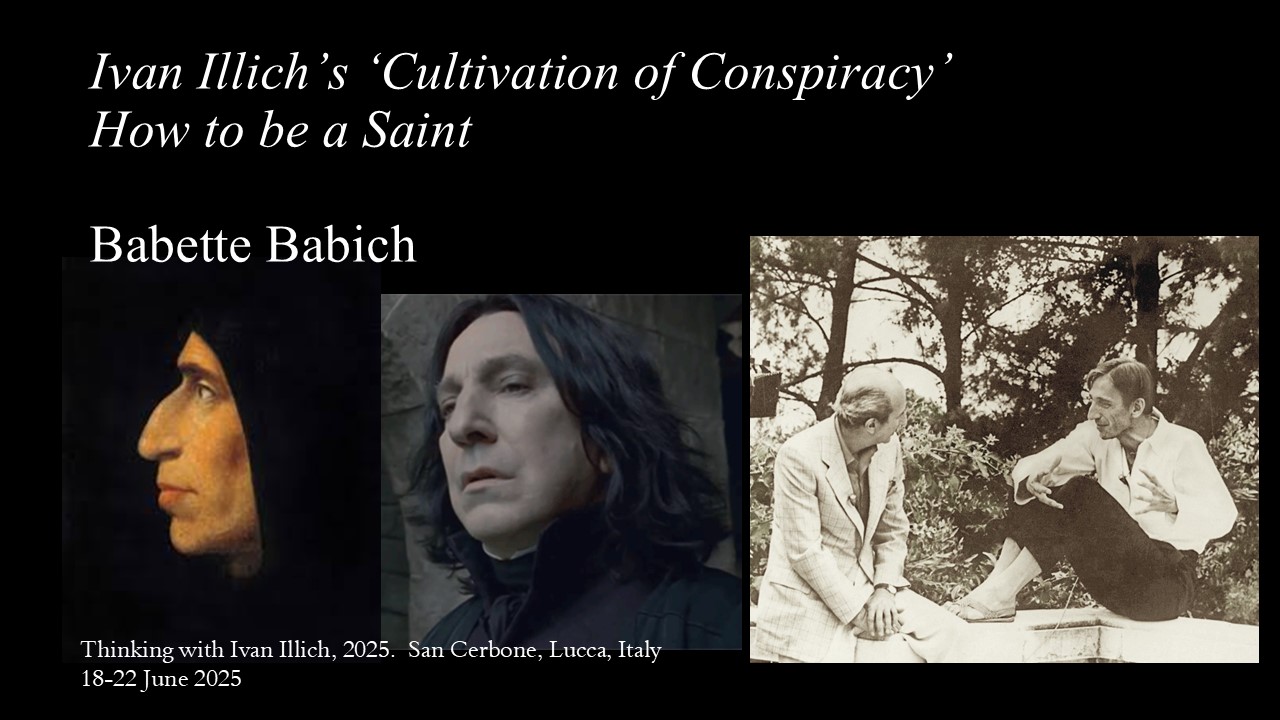

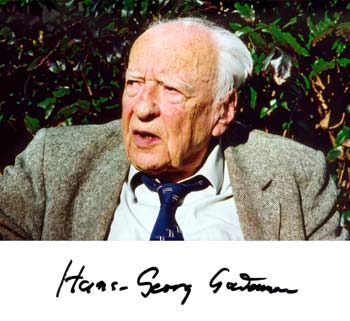





















 Babette Babich